

ABAP Programming
KSeF – the new business reality
The digitisation of invoicing in Poland has entered a crucial phase. With the mandatory implementation of the National e-Invoice System (KSeF), businesses must issue and receive invoices via the Ministry of Finance’s central platform.
This is not merely a technological change, but a genuine transformation of financial processes:
- The way we communicate with business partners is changing
- ERP systems must be adapted
- Organisations must ensure the continuity and stability of their processes
An invoice is only considered to have been issued once it has been validated and assigned a number by the KSeF – which makes integration with the state system a critical element of a company’s operations.
Organisations implementing KSeF face a number of challenges:
Process continuity
Communication issues with KSeF can lead to delays in invoicing and pose business risks – particularly when dealing with large volumes of documents.
The complexity of the SAP environment
Many companies operate as a multi-company group, with varying process configurations and requirements. A solution is needed that combines centralised management with flexibility.
Dealing with emergencies
KSeF downtime, data errors or network failures mean the system must be prepared for various operational scenarios.
Automation
Manual document management on a large scale is inefficient and prone to errors – automation is becoming a necessity.
eGOV-KSEF – a response to business needs
Central operations dashboard
- Management of invoice dispatch and receipt
- Document status monitoring
- Full control over communication with KSeF – all in one place
Operational stability
- Support for emergency and offline modes
- Ensuring business continuity even when KSeF is unavailable
- Minimisation of operational risk
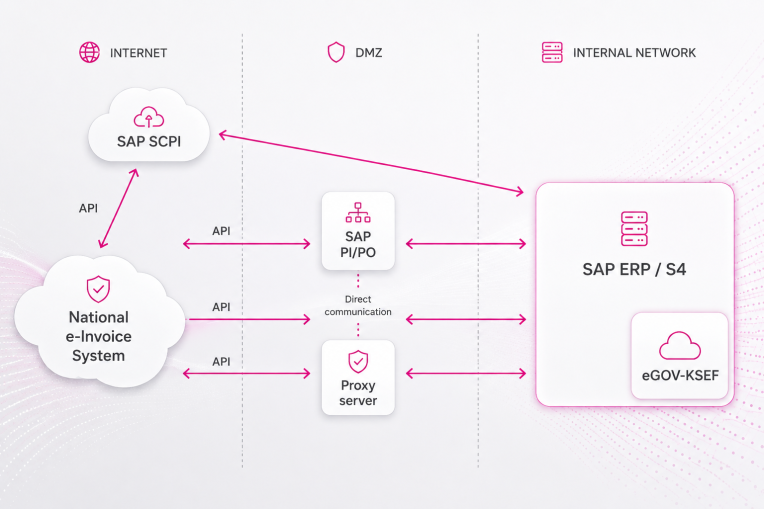
Flexible architecture
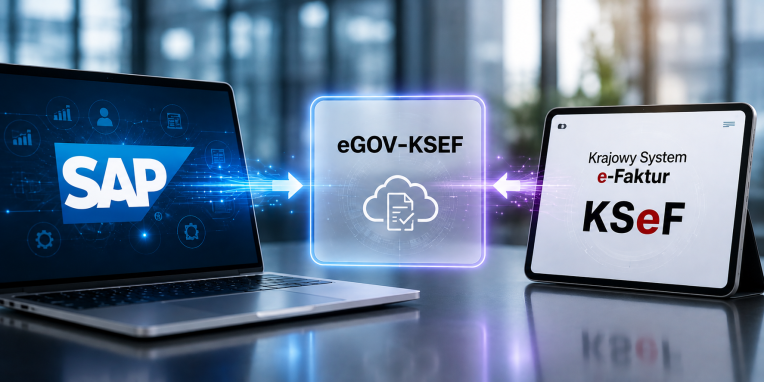
- Ability to integrate SAP directly with KSeF
- Optional use of middleware in more complex environments
Process automation
One of the key elements of eGOV-KSEF is advanced automation:
- Periodic retrieval of document statuses
- Automatic retrieval of purchase invoices
- Updating KSeF numbers in the system
- Validation of documents prior to dispatch
- Regenerating XML in the event of errors
As a result:
- The number of errors is reduced
- The need for manual intervention is reduced
- Processes run continuously and predictably
What makes eGOV-KSEF stand out?
What does the implementation involve?
The implementation process comprises:
- Process and requirements analysis
- Configuration and integration with SAP
- Functional and integration testing
- Production go-live
- Support and solution development
This ensures that the implementation is controlled, predictable and tailored to the specific needs of the organisation.
Prepared for the future
KSeF will continue to develop, and the requirements will change.
eGOV-KSEF has been designed to:
- easily adapt to new regulations
- Support the development of financial processes
- scale alongside the organisation
It is not just an integration tool, but a key element of a long-term digital transformation strategy.
Your contact person

Marek Garbacz
SAP Technology Director